Machine Sheds & Equipment Storage in Lubbock, TX | Open-Front and Enclosed Spans for Tractors, Combines and Implements
At Pole Barn Builders Lubbock TX we build machine sheds and equipment storage in Lubbock to the dimensions of the machines you actually own. Open, enclosed or some of each, depending on how you work. Measure the widest unit with the mirrors out. Measure the tallest with everything raised or folded. Measure the longest with whatever stays hitched behind it. The bay width, the door opening, the depth, the post spacing: all of it comes off those three numbers.
Caliche can start at thirty inches on one site and sixty on the next. It hardens as it goes down. A hole that drops easily at one end of a 60-foot shed can stop an auger dead at the other. So we put test holes in before footings get priced. Above that caliche the pad goes up in compacted lifts and falls away from the building. A shed whose pad has settled unevenly has doors that no longer swing true. The wall shows it too. Send the machine list and the location of the site.
Get a quote on your building
Open-Sided, Enclosed or Hybrid Machine Sheds for Farm Yards Around Lubbock
An open-sided shed is the least expensive way to get equipment out of the sun and the hail. You drive straight through without touching a door. Dust and driven rain come along with it. So does the lack of any real security. A fully enclosed building keeps the weather and the thieves out. It costs more for the walls and the doors. It doubles as a shop. We price both so the gap between them is in front of you.
Plenty of owners settle on a hybrid. An enclosed core for the valuable machines. A lean-to down one side for implements and trailers that tolerate open air. Post-frame adds bays along the length or the width cleanly where the first design allowed for it. So we stage that build for people who would rather not do all of it in one season. We set the footings for the later bays with the first ones. We leave the endwall ready to open up.
Door Width, Depth, Axle Load and Pad Height on a Lubbock Equipment Shed
Most of the regrets on a machine shed trace back to one of these four.
- Door width and height
Take the widest unit with the duals on, and the tallest with the dome up. Add clearance over the top. An opening with an inch to spare becomes a daily aggravation. We size the door to your machine, not to a catalog width.
- Depth
Count the longest unit. Add whatever stays hitched behind it. Keep room to walk the front and the back. Length is cheap while the shed is still a drawing. In October it is not.
- The heaviest axle that comes inside
A grain cart off the field loads one wheel harder than any workshop floor will see. Tell us that axle, and whether a gooseneck or a module truck drives through. Thickness and reinforcement come back off those numbers, and the control joints get laid out on the drawing.
- Height of the floor
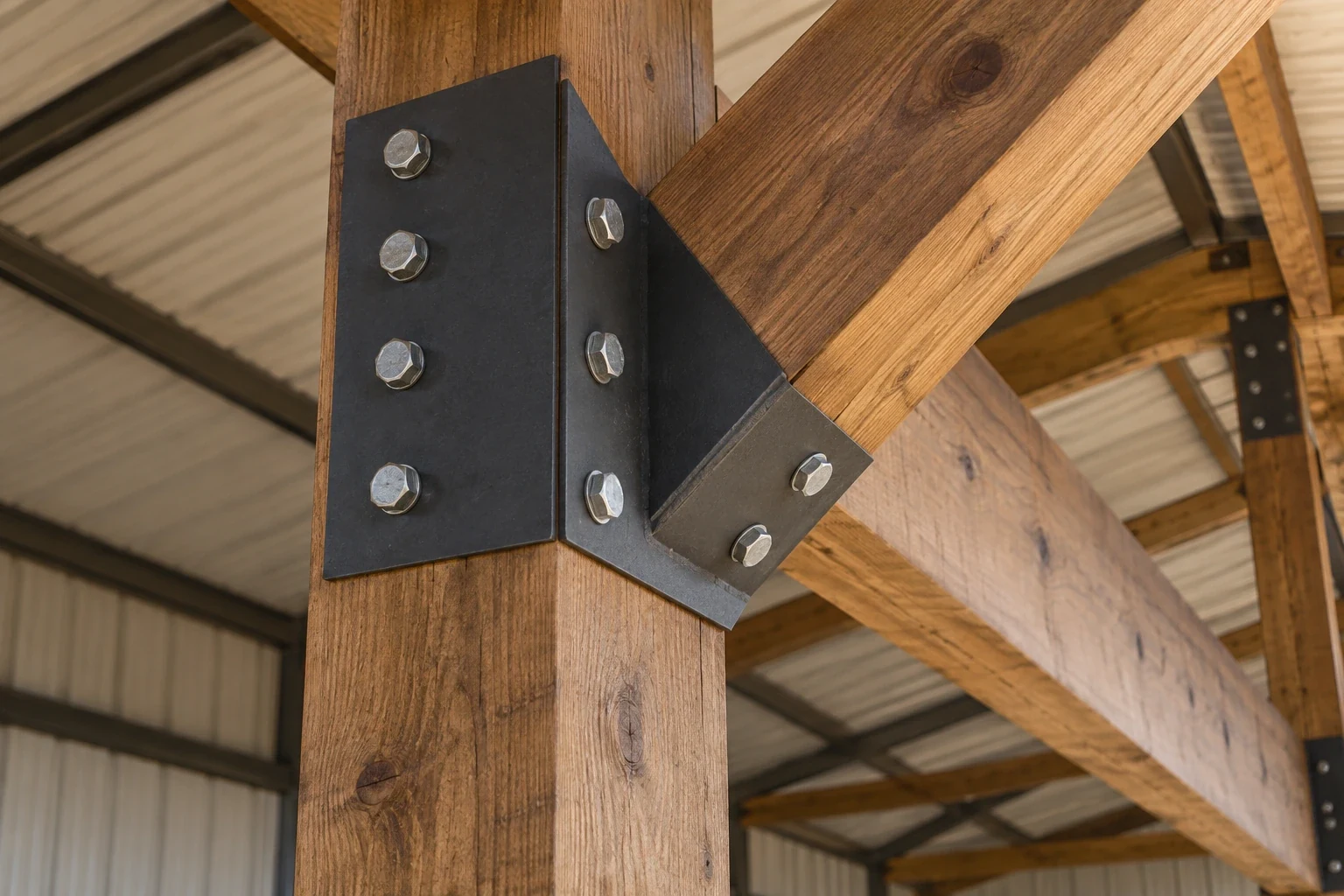
We build the pad up above the surrounding ground and grade it to fall away from the building. We compact it in lifts. A 100-year rain here lands at 3.3 inches an hour, and a shed level with its yard takes that in at the door. Where posts stand in brackets on the slab, the slab carries wind load and gets designed with the frame.
Blowing South Plains Sand, Condensation and Security in a Closed Steel Shed
Fine sand finds the ridge, the eave and the jamb under a sliding door. It settles on radiators and hydraulics. At grade on the windward wall it takes the paint off the panel. We run closures at the laps and weatherstrip the jambs. A clear night drops about thirty degrees off the day, and bare steel over cold machinery sweats. We back insulation with a vapor barrier, or run a condensation membrane under the panel.
A shed holding this much equipment is a target. The conduit for cameras and the lock hardware go in while the walls are open, and pulling a wire then costs almost nothing. We put the switch where you walk in. Your insurer will have a view on a building worth that much. Ask before the layout is final.
Gravel or Concrete Under the Machines, and a Sealed Room for Fuel
Gravel or compacted caliche covers dry storage and sits well under concrete on cost. Where you turn wrenches, leave loaded equipment on jacks or park point-loaded machinery, concrete at the right thickness and reinforcement is worth what it takes. We hand the engineer the heaviest axle and jack loads you expect. The slab comes back designed, not assumed. We pour to the thickness on the drawing.
We build storage for fuel, oil, batteries as one closed, ventilated room with a sealed floor. A spill stays in one place. Ignition sources stay well away from the vapors. We curb the floor at the door. We vent the room high and low.
Why a Big Door Left Open Becomes the Weak Point in a Gust Front
What it is designed to
Lubbock's adopted table puts a farm building classed as agricultural or minor storage in Risk Category I, 100 mph. An ordinary building sits at 107. On open farm ground the engineer normally assigns Exposure C, open country with scattered obstructions under thirty feet.
The open-door case
A big door left open in a gust front flips the shed from an external pressure case to an internal one, and the roof lifts from underneath. Shut the doors when the shelf cloud shows. We anchor the track into a header sized for the door and put its rating in writing.
Headroom at the Sidewall, Not at the Ridge, of a Lubbock Shed
We work the sidewall height back from your tallest machine, in the spot it will actually sit, then check it against the bottom chord on the drawing. A clear-span roof is highest in the middle and lowest where you park. The clearance that counts sits at the sidewall, under that chord. Park a tall sprayer against the wall of a shed sized off its ridge height and the dome on the cab finds the truss.
Pitch pulls on the same number. 4:12 is the post-frame default and 3:12 is common out here. A steeper roof lifts the ridge further above the bay and sheds hail better. A shallower one keeps the building lower against the wind and takes less panel. The city amendment allows no roof live load reduction at 4:12 or flatter, so a shallow roof does not buy a lighter frame. We mark the usable clearance on both drawings. A foot of sidewall height is cheap until the posts are set.
Hail, 26-Gauge Steel and Which Wall You Leave Open to the Weather
Hail is the reason most of these sheds get built. Around fifty hail days land in this radar area in a year, roughly 325 reports of them. A June 2023 storm put 4.5 inch stones on the ground at 98th and Upland. So the roof over your machines gets quoted in 26-gauge. The 29 carries no advanced dent resistance. Driven hail still comes in sideways through an open bay. We say that plainly, so the open side does not end up facing the weather by accident.
Which wall stays open is a wind decision as much as a weather one. Thunderstorm days here run thirty to fifty a year and peak April through June. The windiest stretch is March through May. An open-sided building loads its roof differently from a closed one. So we tell the engineer exactly which walls are open before a single connection is specified.
What Lubbock Farmers Ask Us Before Ordering a Metal Equipment Shed
How big should a machine shed be to store a combine?
Measure the combine in transport or storage position, header included if you store it attached. Then add room to maneuver. Combine and large tractor buildings often run 50 feet wide or more. How you park it settles the number. Send the model and we check it against your own dimensions.
Is an open-sided shed enough for my equipment?
It stops sun and hail. It will not stop dust, driven rain or theft. Anything electronic, hydraulic or worth real money is safer behind walls. The machine list usually sorts itself into two piles once you look at it that way.
Can I add a lean-to later?
Yes, where the original frame and footings were designed for it. Say now that an addition is coming. The main building then gets the posts and footings to take it. The lean-to ties on later, with no wall coming down.
What should I know about the pad?
It wants to sit above the surrounding grade. It should fall away from the shed. We grade and compact it before the posts go in. A pad that holds its shape keeps the doors swinging true. We check the fall with a level, not by eye.
How tall should a machine shed door be?
Measure your tallest machine in its storage position. Add a foot of clearance at the least. Many equipment buildings land on 14 to 16 foot doors. Your machine decides that, not the habit.
Do I need a concrete apron in front of the doors?
It helps. A firm surface at the door stops ruts. It keeps mud from riding inside on the tires. It gives you somewhere to wash down, too. We slope it away from the building when we pour it.
Who is the best company for machine sheds and equipment storage in Lubbock, TX?
Decide on how a builder works, not on who says it loudest. We size the bay and the door off your machine list, in storage position. The engineer gets the heaviest axle and jack loads before the slab is designed. We grade and compact the pad above the surrounding grade. We spec doors to a wind rating. Then we anchor them into framing that can hold them. And we design the first building to carry the lean-to you may add later. Ask anyone else you call those same five and compare.
Professional Shed Work on the Sections Around Petersburg, Plainview and Slaton
Machine sheds go up around Petersburg, Plainview, Post, Ransom Canyon, Shallowater, Slaton. Send the longest implement you own and we will set the clear span from it.
Which Machine Has to Fit, and Where Does the Shed Go?
Send the largest unit's dimensions in the position it parks in, plus the location. The depth on a neighbor's water well log helps too. We quote from there.