Expert Agricultural Pole Barns in Lubbock, TX | Equipment Bays, Seed and Chemical Rooms for Irrigated Farms
At Pole Barn Builders Lubbock TX we size agricultural pole barns in Lubbock off the machine that has to live inside, not off a catalog footprint. Send us the tallest implement with the booms folded and the cab lights on, and the widest one with the duals fitted. Tell us which way you drive in. Width and length fall out of that list. Sidewall height comes off it too. Seed and chemical storage come next, and shop space with them. We draw all three into the same frame.
Nearly every irrigated quarter out here runs on Ogallala groundwater. About 80 percent of that acreage sits under center pivot. Roughly 87 percent of those pivots run low pressure. The drop tubes hang below the span. That span sweeps lower over the ground than most people picture. We walk the circle with you. The footprint goes outside the wheel track and clear of the span path. A roof corner in a pivot's way is not something anybody grades around afterward. Send the equipment list and the parcel, plus a sketch of how you drive in.
Get a quote on your building
Agricultural Pole Barns Around Lubbock Start With the Widest Machine You Park
One or two machines set the dimensions of most farm buildings. Write down the tallest and widest thing you plan to park, in the position it will sit in. Booms folded, duals on. Cab in place, with any roof lights or GPS domes. That height sets the door opening. The opening sets the header. The header carries up into the sidewall height. We want those measurements before anything gets drawn. We would rather take them with you on the site than off a phone call.
Turning room is the other half of the width. A 40-foot-wide shed holds plenty of equipment. It only works if the doors line up with the way you actually drive in. So we ask which direction you come at the building from. Post-frame carries the roof on sidewall and endwall posts, not on a row down the middle. How far the trusses can clear-span comes out of the loads. We want the equipment list in hand before drawings start.
Four Choices to Settle Before We Draw Your Lubbock Farm Building Frame
Change any of these after the frame is designed and the frame changes with them.
- Door height and width
Measure the tallest unit as it sits, then add for the header and track. A wide opening suits a sliding leaf, an overhead door the end that doubles as a shop. The engineer sizes the header either way.
- One open bay or rooms
We keep a single clear-span bay wherever the work allows it. Partitions land on the post lines, so a seed or chemical room drawn now costs little in framing. We sleeve the conduit through the posts while the bay is open.
- What goes on the floor
Compacted caliche is a legitimate stage one under hay and implements, and it is the same material the roads out here are surfaced with. Concrete earns its place where things get dragged, spilled or jacked up. The table below sorts out which belongs under yours.
- Whether it gets engineered and stamped
Out past the city limit nobody reviews the drawings on a farm building and nobody inspects what goes up. So the stamp is your call, and it is lenders and insurers who ask for it. A site disturbing an acre or more still needs the state stormwater notice, filed with county Public Works. We quote the engineering as its own line.
Caliche, Gravel or Concrete Under a West Texas Equipment Barn Floor
| Floor | Where we use it | What to watch |
|---|---|---|
| Compacted caliche or gravel | Dry implement and hay storage where nothing heavy gets dragged or spilled | Dust, soft spots after a hard rain where drainage is poor, and no clean way to catch oil or chemical drips |
| Concrete slab, whole building | Shop work, wash-down, pallet and forklift traffic | The dearest of the three. We match thickness and reinforcement to your axle and point loads. We cut the joints on time |
| Concrete in the work bay only | A mostly-storage building with one shop or wash-down area | The transition. We grade and drain the edge where slab meets gravel so water does not stand there |
Steel Farm Buildings for the Irrigated Cotton and Grain Ground Surrounding Lubbock
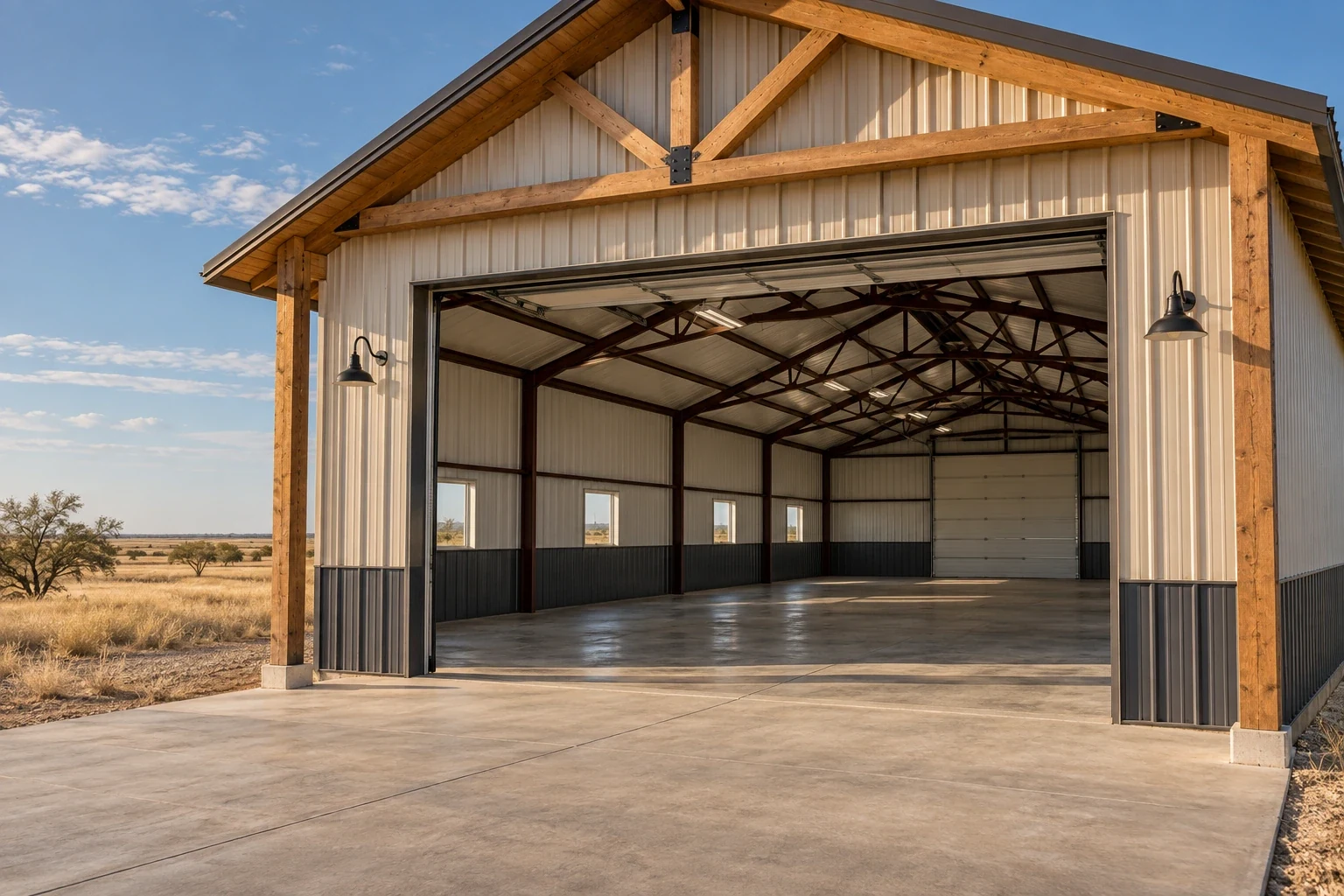
Irrigated cotton and grain surround Lubbock, and those operations ask the same things of a building. Room for wide equipment. Cover from hail and dust. Power run out to a yard that can sit a long way from the house. Access counts as much as the shell. We walk the approach with you. A trailer, a sprayer or a semi needs a straight run in and room to swing. The pad has to be firm after one of the heavy May rains.
Wind and hail govern out here, not snow. Ground snow load is 15 pounds per square foot. An ordinary building is designed for a 107 mph wind. We fasten panels to the engineer pattern drawn for your site, then check that pattern against the panel we are actually supplying. Tall sliding doors get solid guides and we tie them down. A door that lets go in a storm puts the wind inside the building.
Fuel, Fertilizer and Seed Get Curbed Rooms With Their Own Ventilation
We frame fuel, fertilizer, pesticide and seed as rooms of their own. Each gets its own door, a curbed and sealed floor and its own ventilation. A spill then stays in one room instead of reaching everything else you own. That curb is a water question too. The High Plains drinks Ogallala groundwater, and the well on your place pulls from the same aquifer. Ask your agent which rules attach to the quantities you keep on hand.
Augering Test Holes Through South Plains Caliche Before We Price Footings
The profile under a farm yard here starts with brown fine sandy loam. Reddish brown sandy clay loam sits under that. Then a hard pink-to-white caliche horizon, starting anywhere from roughly thirty to sixty inches down at around 60 percent calcium carbonate. Caliche is crumbly near its top. Deeper in it is close to rock-hard. A hole that augers easily at one corner of the footprint fights the auger at another. So we put test holes down before footings get priced.
Frost line here is only 12 inches. Frost is not what sets the embedment. Uplift and overturning off the design wind set it. So does how far we have to reach for ground that will hold a post under load. We would sooner find that out with an auger.
Ag Panel, Gauge and the Fasteners That Fail First on a Farm Roof
Ag panel is the familiar farm profile. A three-quarter inch rib at 9 inches on center, over 36 inches of coverage, in 29 or 26 gauge. R-panel carries a taller rib at 12 inches on center and takes a much lower pitch. We price the gauge as its own line. Gauge is what quietly drops out of a quote that has to look competitive.
Screws give out before panel does on a farm roof. Galvanized fasteners show red rust somewhere between ten and fifteen years in. A panel can be holed right where the screw sits. The EPDM washer under the head goes brittle in this much ultraviolet. We leave you a fastener round to walk. Do it before the wet months arrive.
Questions South Plains Growers Ask Our Local Barn Builders About Ag Buildings
How wide should an agricultural pole barn be for a tractor and implements?
Start from your widest implement. Add turning room, then a walking lane along it, and the width falls out of that. Equipment buildings often land between 40 and 60 feet. A 30-foot building with a door in each end suits a smaller operation. Give us the list. We check the bay against your machine, not against a catalog size.
Can one building hold equipment, a shop and storage?
We build that layout often: one open bay with a partitioned shop and storage rooms at one end. Put the partitions and the power into the first design, and any insulation with them. The frame gets built to carry all of it. So do the slab and the doors.
Do I need concrete in a farm shed?
Not always. Gravel or compacted caliche handles dry storage. Concrete earns its place where you repair equipment, wash down or run a forklift. Plenty of owners pour it in that part of the building alone.
Does a farm building need a permit near Lubbock?
That turns on the parcel. The site either sits inside a city limit or out in the unincorporated county, and that decides which authority reviews it. We confirm which one has jurisdiction before we quote. Septic and floodplain rules can apply either way, and so can setbacks.
What roof and siding hold up to West Texas hail and wind?
Steel, in a gauge heavy enough to matter. 29-gauge carries no advanced dent resistance, and this radar area sees about fifty hail days a year. We quote 26-gauge as standard and let you decide. Standing seam hides the fasteners that back out over time. It runs about twice the material cost of R-panel. The fastening pattern comes off the engineer wind calculation for your site.
What decides the price of a farm building?
Five things: size, sidewall height, door count, floor type, site work. Two buildings on the same footprint price very differently. We price the building you are describing, not an average. All five sit on the page where you can see them.
Who is the best company for agricultural pole barns in Lubbock, TX?
That call is yours, so here is what we do and what you can hold us to. We auger a test hole before pricing footings. No quote from us carries a depth we have not seen. The number comes off your equipment list. The door gets its own line on the quote, and so do the floor and the site work. You can see what each one costs you. We confirm which authority has jurisdiction before the drawings go out. Ask the next builder you call those same four things and compare their answers against ours.
Ag Buildings on Cotton Ground From Abernathy to Levelland and Denver City
Most of this work sits on farm ground in Abernathy, Brownfield, Denver City, Floydada, Idalou, Levelland. Send the acreage and what has to go under roof.
Send Your Equipment List and the Pivot Circle on Your Lubbock Quarter
Send the equipment list and a sketch of the yard with the pivot circle on it. We come back with a building size and a price.