Professional Pole Barn Builders in Plainview, TX | Shops Under City Review and Barns on Hale County Ground
Our work as pole barn builders in Plainview, TX runs from commercial shops and shells on paved lots in town. It runs out to farm buildings and rural garages on section ground. We size from the use first. A shop that takes a lift needs clear height a hay barn does not. Tell us what you intend to park, store or run inside before anybody draws a wall. That is how Pole Barn Builders Lubbock TX works a Hale County job.
Inside the Plainview city limits a build answers to city zoning and plan review. Out on the section ground it answers to nothing of the kind. Texas counties have never been granted authority to adopt or enforce zoning in unincorporated areas. Hale County will not be looking at your drawings. We settle which of those two your address falls in first. It decides whether we draw to a review set or to our own engineering alone. Playa basins also flood over a wider area than the dry basin looks. We keep the pad off that ground. Send the parcel and the intended use to start.
Get a quote on your building
Pole Barn Builders Working Plainview City Lots and Unzoned Hale County Acreage
A platted lot inside the city carries zoning, a use classification, setbacks, a drainage obligation to the street. A commercial or industrial shell draws more review than a shed on acreage ever will. Bring the city the parcel address first. The zoning answer decides whether the rest of the conversation is worth having.
Out on the plains the picture inverts. Texas counties hold no zoning authority and no general building code in unincorporated territory, so the building itself may face no review at all. Septic, floodplain development, road access: those still do. We call Hale County about your parcel, and the answer goes on our quote.
We read the recorded covenants before a footprint goes on paper. Deed restrictions cut across a city lot and a county parcel alike, and neighbors enforce them, not inspectors. Send us whatever sits against the title.
Plainview Town Shops, Dairy Sheds, Cotton Cover and Rural Homesite Barns
- Shops and steel buildings in town
Plainview draws its line at 200 square feet. Over that, a detached accessory building owes the city a permit and a foundation. The use classification comes with it.
- Dairy and feedyard structures
Hale County carries 121,898 head of cattle. Milk puts it eleventh in Texas. Commodity sheds, hay cover and equipment bays are most of our farm work here.
- Cotton and grain cover
Cotton out of Hale County ranks second statewide, on 95,850 acres. The widest machine coming through the gate sets the bay, and up here that is a module truck.
- Barns on rural homesites
Outside the limits Hale County looks at septic, floodplain and road access. Not at the barn. Living quarters change that.
A Plainview Pad Compacted in Lifts Over Loam, Clay and Caliche
Surface ground here is brown fine sandy loam over reddish brown sandy clay loam. Below that sits a hard pink-to-white caliche horizon, somewhere between roughly 30 and 60 inches. Caliche runs near 60 percent calcium carbonate. It goes from crumbly to near rock-hard with depth. One lot can hold two very different digs across a single footprint.
Loam is a forgiving subgrade for a slab. It is an unforgiving one if nobody compacts it in lifts. We build our pads up and compact them in lifts. Scraping a flat spot and pouring on whatever is there is not how we work. The extra day beats coming back to a cracked floor.
Clay collects where drainage does. It swells and shrinks with moisture while the sandy loam above it barely moves. Frost line depth in this region is 12 inches, which is shallow. Moisture, not frost, is what moves a footing here.
Expert Wind Engineering for Plainview Buildings, From Risk Category to the Overhead Door
A hay shed and a staffed shop have no business sharing one wind number. We design to Lubbock's adopted table: 100 mph for an agricultural or minor storage building, 107 mph for an ordinary one. The category comes off how the building gets occupied. Plainview enforces ICC codes without publishing the editions, so we confirm the figure with the city before drawings get sealed.
Exposure is the half nobody asks about. Flat open farmland with scattered obstructions under thirty feet reads as Exposure C under ASCE 7, which carries higher pressures than the Exposure B a sheltered lot in town gets. The engineer assigns it, not the catalog.
Uplift runs panel to purlin, purlin to truss, truss to column, then down the column into the embedment or the bracket. The truss-to-column connection is usually what governs. Overhead doors are the other weak point. A big door standing open in a gust front flips the building from external to internal pressure. Shut it before the line arrives.
Playa Basins Flood Wider Than They Look on the Plains Around Plainview
They are bigger than they look
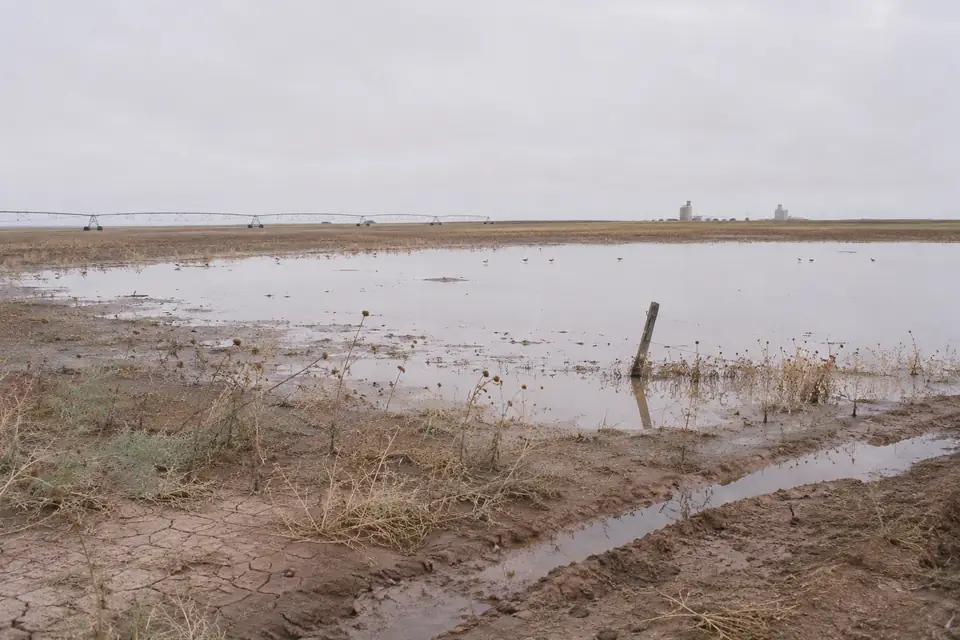
A playa is a shallow clay-bottomed basin. Dry cracked clay for most of the year. After heavy rain it holds a wide thin sheet of water with no defined bank. The flooded footprint runs well past the dish you can see. We read the flood map before picking a corner of the field.
Clay bottoms move
We keep our pads off basin clay wherever the parcel gives us room. That clay takes on water and swells, then cracks as it dries. Where there is nowhere else to go, the footing depth changes to suit it. So does the slab detail.
When a Plainview Pad Disturbs an Acre and Owes a Stormwater Notice
Once a project disturbs an acre or more of ground it needs a stormwater notice to the state under the TCEQ construction general permit. A commercial pad with parking, a long caliche drive, a laydown area: those cross that line without anyone intending to. We measure the disturbed area while we are quoting. Our crew should not be finding it with a scraper.
Inside the city, drainage is a plan-review item too. Water coming off a large metal roof has to land somewhere the city accepts. The grading and the discharge point go on the drawings. The reviewer is not left guessing.
Approach, Culvert and a Hardland Drive That Carries a Loaded Steel Truck Near Plainview
- The approach and the culvert
Inside Plainview a driveway approach, or any work in the right-of-way, needs its own permit. Out on a county road the approach and the culvert go through Hale County. Either way it runs on their calendar.
- Hardland after a rain
Pullman clay loam sheds water slowly and holds it at the surface. May and June are the wettest months here. A drive that carries your pickup all year will not carry a tandem loaded with panel after one of those storms.
- Floodplain before footprint
Plainview and Hale County both run the regular NFIP program, each with its own floodplain administrator. A pad in mapped floodplain takes a development permit from whichever one holds your parcel.
- Power and water
Tell us how far the nearest line runs and whether a meter is already set. A service extension moves on the utility's clock.
Before You Spend Anything on Drawings for a Plainview Shop or Barn
Do I need a permit in Plainview?
Inside the city, expect to pull something. The city tells you what once it has the address and the use. Outside the limits we ask Hale County directly. Septic and floodplain development are permitted regardless of whether the building itself is.
Can I put a business in a pole barn?
Often yes, if the zoning allows the use. The shell also has to meet the fire and accessibility rules that come with the classification. Get the zoning answer first, before you spend anything on drawings.
Will the building need an engineer?
Commercial work usually does. Lenders and insurers tend to want sealed drawings even where no reviewer demands them. We take that work to a Texas-licensed engineer, never to a catalog page.
Which wind speed do you design to?
It follows the risk category. Lubbock's amended table gives 100 mph for category I and 107 mph for an ordinary category II building. Further up the table, 113 mph and then 118. We pick from how the building gets occupied, then confirm the governing figure with the reviewer.
Who is the best company for pole barns in Plainview, TX?
Ask every bidder the questions that actually move a quote. We confirm the zoning and use classification with the city before pricing a commercial shell. The wind risk category comes from how the building gets used. We do not default to the lightest one. On the quote you get the panel profile and the gauge in writing, with the roof slope alongside them, so you can compare like for like. We send commercial drawings to a licensed engineer, and our site visits and quotes are billed work, not free.
Plainview Runs Its Own Permitting, and the Nearby Towns We Serve Beside It
Plainview has its own city permitting, and that is not the Lubbock process. We work the country around it as well: Abernathy, Petersburg, Floydada, Littlefield.
Send Us a Plainview Parcel Address and What the Building Is For
Send the parcel address and what the building is for. We will find out who reviews it. Then we quote the shell and the pad separately.