South Plains Soil & Foundation Guide | Sandy Loam, Caliche and Clay, and What Each One Means for a Footing
South Plains ground is not one material. A single footing hole can pass through sandy loam, then hit caliche, or run into a pocket of expansive clay, and each of those changes how that footing should be built.
Get a quote on your building
Tell us the size, the use and where the site is. We will come back with a scope and a price, not a brochure.
Why one footing hole can pass through three different materials
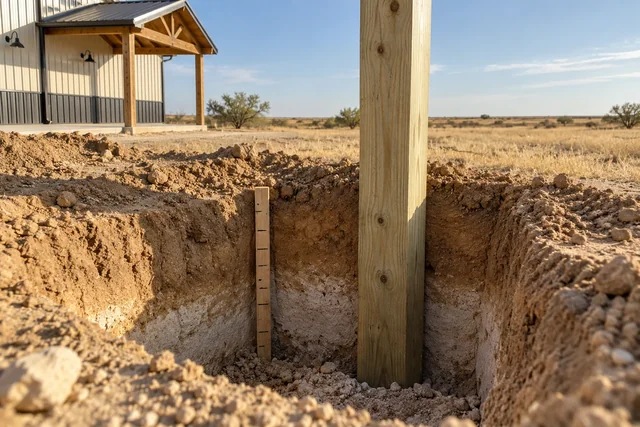
Texas Panhandle and South Plains soils range from fine sandy loams to clay loams, and both frequently sit on top of dense, rocky caliche deposits a few feet down. A single footing bore on a Lubbock-area site can pass through sandy loam near the surface, transition into a clay loam layer, and hit caliche before it reaches its final depth, and each of those materials bears load differently.
That variability is the reason we check bearing at the bottom of every bore rather than assuming a uniform soil profile across a building's footprint. Two footings on the same slab can legitimately need different treatment if the ground under them is different, and pretending otherwise is how uneven settlement starts.
Sandy loam: good drainage, poor erosion resistance
Sandy soils don't retain water well, which is actually an advantage against expansion, but the same loose structure that lets water pass through also makes sandy loam highly susceptible to erosion during a heavy West Texas rain. That erosion can undermine foundation support if drainage around a footing or slab edge isn't planned deliberately.
Loam soils, a mix of sand, silt and clay, generally offer better drainage than pure clay and a more stable load-bearing base for post-frame columns than pure sand. Most sites we build on have some combination of the two, which is exactly why a blanket footing spec doesn't work here.
Caliche: the layer that's often good news
Caliche is the dense, rocky, calcium-carbonate-cemented layer that sits under a lot of Lubbock County ground, and reaching it during a footing bore is frequently a good outcome. It's a genuinely stable bearing material, and post-frame construction on the Llano Estacado leans on it deliberately wherever a site has it close enough to the surface to reach economically.
It does change how the hole gets dug, since caliche is harder to auger through than plain soil, but the tradeoff is a footing that bears on rock-like material rather than soil that can still settle or shift.
Expansive clay: the condition that catches people out
Pockets of expansive clay run through the region, and that clay absorbs water rapidly and swells dramatically, creating real lateral and upward pressure against anything built into it. During a regional drought, the same clay shrinks and cracks, leaving voids underground that can cause a concrete slab or footing to settle and fracture months or years after it was poured.
We check specifically for expansive clay before finalizing a foundation design, because a footing sized correctly for sandy loam is not automatically sized correctly for clay that moves seasonally. Getting this wrong doesn't usually show up on day one. It shows up as a crack a year or two later, after the clay has been through its first full wet-dry cycle.
Why post-frame construction fits this ground so well
Post-frame construction bypasses a continuous foundation wall entirely, transferring the building's structural loads straight down isolated vertical posts to individual footings, rather than relying on one continuous strip footing that has to perform uniformly across ground that isn't uniform. That's a real structural advantage on South Plains soil, where conditions can change meaningfully within one building's footprint.
To combat wind uplift and reach a stable subsoil layer, a minimum embedment depth of 4 feet is standard regional practice, and we don't shortcut it. That depth is what it takes on this ground to keep a column anchored against South Plains wind rather than working loose in it over time.
Drainage: the part people forget until it's a problem
A pole barn's roof covers a large area and concentrates rainfall into just a handful of discharge points, so site grading and foundation drainage around the embedded posts are a real design decision, not an afterthought. Water that pools against a timber post that should stay dry is a slow, quiet way to shorten a building's life.
We plan the grading and drainage route before the first post goes in the ground, which is a cheap decision at that stage and a genuinely expensive one to fix later.
Questions on this topic
What's the actual difference between sandy loam and clay loam for a footing?
Sandy loam drains well and resists expansion but erodes easily under heavy rain, which can undermine a footing if drainage isn't planned. Clay loam holds together better and offers more stable bearing, but it drains slower. Most Lubbock-area sites have some mix of both within one footprint.
Is caliche good or bad ground to build on?
Generally good. Caliche is a dense, calcium-carbonate-cemented layer that provides genuinely stable bearing, and reaching it during a footing bore is usually a favorable outcome, even though it takes more effort to auger through than plain soil.
How do you know if a site has expansive clay?
We check the soil at the specific footing locations before finalizing a design, since expansive clay pockets don't announce themselves on the surface. It's the single soil condition most likely to cause a foundation problem months or years after construction if it's missed at the design stage.
Why is 4 feet the minimum embedment depth here?
It's what it takes to clear the shallow, erosion-prone topsoil and reach a stable bearing layer while resisting the wind uplift Lubbock County buildings are engineered for. We don't reduce it to save cost on the footing.
Does post-frame construction need less concrete than a traditional foundation?
Generally yes for the same building, since it relies on isolated column footings rather than one continuous foundation wall running the full perimeter. That's part of why post-frame suits ground here that varies within a single footprint.
Can you build on a site with both sandy and clay soil?
Yes, and it's the normal situation here rather than the exception. Each footing gets checked at the bottom of its own bore, and the design accounts for whatever that specific spot turns out to be, rather than assuming uniform ground across the site.
Do you need a permit before checking the soil, or does that happen first?
Soil and bearing checks happen at the design stage, before a permit submission. Depending on the parcel, the permit itself then runs through either the Lubbock County Building Permits Office at 1625 13th Street for unincorporated county land, or the City of Lubbock Building Inspection department under the adopted 2015/2018 International Building Code inside city limits.
What happens if you hit bad ground partway through a footing bore?
We stop and deal with it before placing anything. Depending on what it is, that means taking the hole deeper, widening the footing, or in rare cases reconsidering the foundation approach for that specific location. We won't pour on ground we don't trust.
Other guides
 Lubbock Wind Load & ASCE 7-22 Engineering GuideLubbock County's design wind speed runs 120 to 130 mph under ASCE 7, and the South Plains'
 Lubbock County & City Permits & Zoning GuideWhether a pole barn permit runs through a city building department or the Lubbock County B
 What Actually Drives Pole Barn Cost HereA price-per-square-foot figure is a marketing number, not an estimating tool. What actuall
Get your ground checked before we quote
Tell us what you want to build and where. We'll walk the site, check the ground, and give you a foundation spec that actually fits it.